 Kinfoly
What Is a Second Cousin Once Removed? Cousin Relationships, Explained
Your mother's first cousin comes to the wedding. Someone introduces her as your second cousin, someone else says "a cousin once removed", and the conversation moves on before anyone settles it. Every family has a relative like that: close enough to know, too far to name.
The naming system is shorter than it sounds. It is two numbers, both counted up to the same ancestor, and once you have them every cousin in the family has exactly one name.
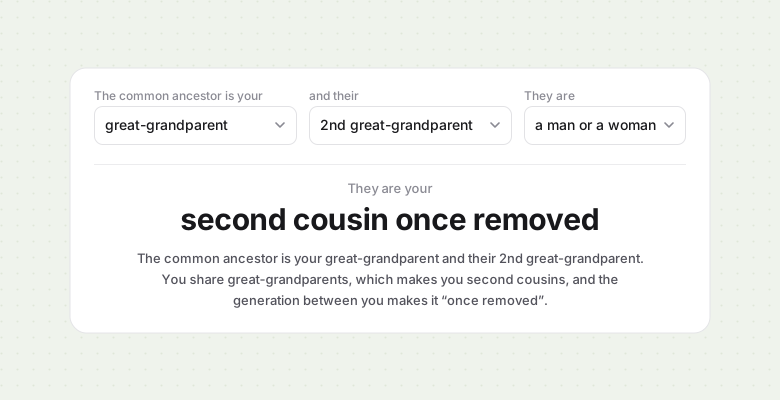
What is a second cousin once removed?
A second cousin once removed is the child of your second cousin, or the second cousin of your parent. Either way, the two of you descend from the same ancestors, and they are great-grandparents to one of you and 2nd great-grandparents to the other.
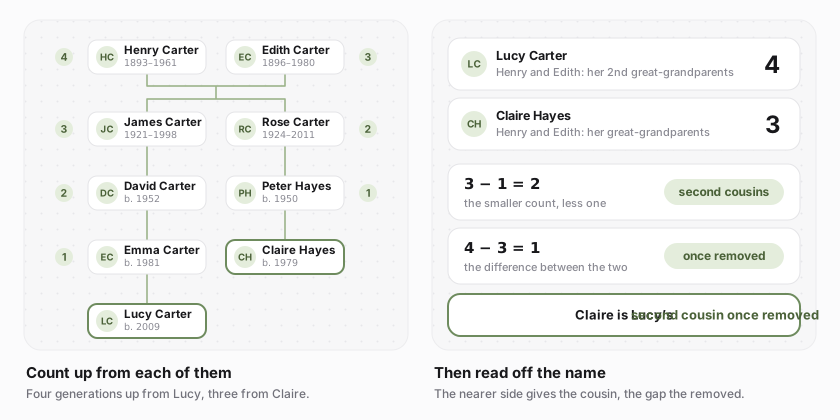
Take the Carters. Henry and Edith Carter had two children, James and Rose. James's great-granddaughter is Lucy; Rose's granddaughter is Claire. Henry and Edith are Claire's great-grandparents and Lucy's 2nd great-grandparents, so Claire is Lucy's second cousin once removed — and Lucy is Claire's. The name is the same in both directions.
How to work out any cousin relationship
- Find the nearest common ancestor — the most recent person, or couple, you both descend from.
- Count the generations from each of you up to them. A parent is one, a grandparent two, a great-grandparent three.
- The smaller count, less one, is the cousin. Grandparents in common make first cousins, great-grandparents second cousins, 2nd great-grandparents third cousins.
- The difference between the two counts is how many times removed. If the counts are equal, you are not removed at all.
From Lucy up to Henry and Edith is four generations; from Claire, three. Three less one is two, so they are second cousins. Four minus three is one, so they are once removed.
What is a first cousin once removed?
"Removed" means a generation apart, and it works in both directions. Your first cousin's child is your first cousin once removed — and so is your parent's first cousin, the woman at the wedding. Twice removed is two generations apart: your first cousin's grandchild, or your grandparent's first cousin. In the Carter tree, Peter Hayes is Emma's first cousin once removed, because he is her father David's first cousin.
The most common mix-up is calling a cousin's child a "second cousin". That child is a second cousin to your children, not to you.
Half cousins and double cousins
When the nearest common ancestor is one person rather than a couple, the relationship is half. If your parent and theirs share a father but not a mother, you are half first cousins; the same goes for a half-brother or a half-aunt. When two brothers marry two sisters, their children share all four grandparents and are double first cousins, related twice over through two couples.
A cousin chart cannot show either, because it only knows how far up the common ancestor sits. The calculator can, once it has your family tree file to read — more on that below.
Grandaunts, great-aunts and 2nd great-grandparents
If one of you is a child of the common ancestor and the other a grandchild or further down, there is no cousin: the other is your aunt or uncle, niece or nephew, with a rung of grand- or great- for each generation further out. Your grandparent's sister is your grandaunt (also called great-aunt). Genealogists write grandaunt, to match grandparent, and most families say great-aunt — both mean the same woman. Rose Carter is Emma's grandaunt and Lucy's great-grandaunt, which most families would call great-great-aunt.
On the direct line, past great-grandparent the greats are numbered: a great-great-grandfather is a 2nd great-grandfather, and one generation further back is a 3rd great-grandfather. Henry Carter is Lucy's 2nd great-grandfather.
How to use the relationship calculator and cousin chart
The free relationship calculator does the counting for you, in two ways, and needs no account.
From the common ancestor. Say who the shared ancestor is to you and to the other person — "your great-grandparent", "their 2nd great-grandparent" — and the answer appears underneath, with the everyday name where there is one and a sentence explaining it. The lists go ten generations up each side, as far as an 8th great-grandparent, and a third, They are, chooses between grandaunt and granduncle, niece and nephew.
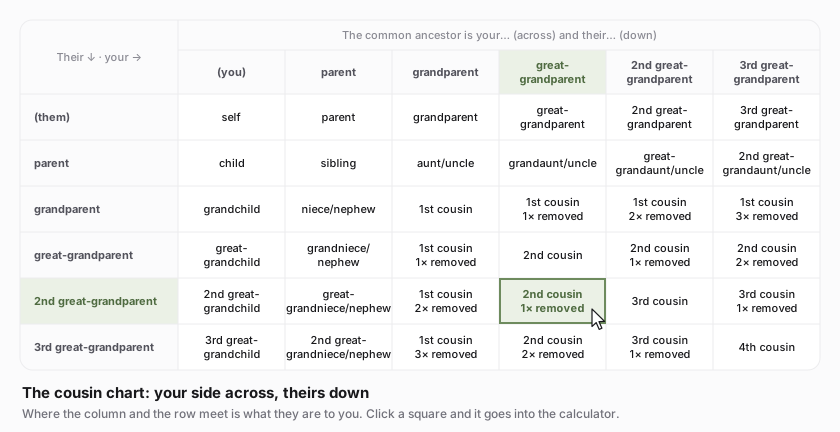
Under it is a cousin chart, your side across the top and theirs down the side, from parents and siblings out to fifth cousins. Click a square and it goes into the calculator.
From your family tree file. Drop a GEDCOM file — a .ged in GEDCOM 5.5, 5.5.1 or 7.0, up
to 50 MB — and pick two people by typing their names. The calculator finds the nearest
common ancestors in the file, names the relationship, and shows the line from those
ancestors down to each person side by side. It also answers what the chart cannot: it says
half when the two lines come down through children of different partners (it needs both
parents of each child in the file to say so), lists double cousins once for each couple, and
names relatives one marriage away — an uncle by marriage, a father-in-law, a stepmother, a
first cousin's wife.
The file is read by code running in your browser and is never uploaded. If you have no file to hand, there is a sample tree to try it on.
The calculator is one of Kinfoly's free genealogy tools; none of them asks for an
account, and none sends your file anywhere. If you are not sure where a .ged file comes
from or what is inside one, start with what a GEDCOM file is;
and once the cousins you have just named add up to four hundred people,
how to read a big family tree shows them one line at
a time.